TL;DR
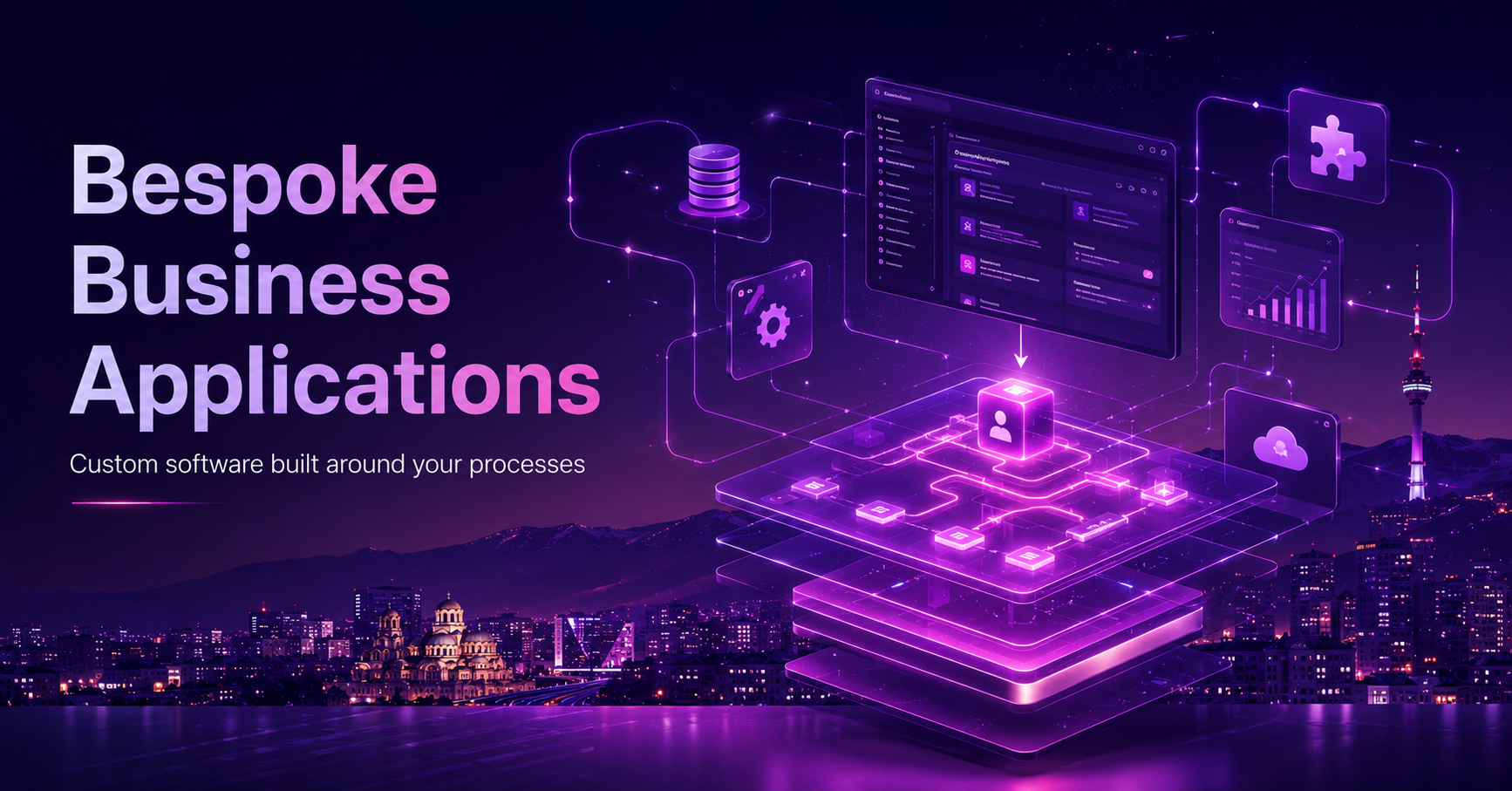
- Bespoke business applications are custom-built software designed around your exact processes - not generic tools you bend your operations to fit.
- When it's worth it: unique workflows, specific compliance needs, or competitive advantages that depend on proprietary technology.
- Investment: typically €15,000-€500,000+ over 3-18 months, with ROI potential of 200-400% through efficiency gains.
- The payoff: perfect operational alignment, proprietary capabilities competitors can't replicate, and a system that scales with you instead of constraining you.
Custom business applications have become essential for companies seeking competitive advantages through technology that aligns precisely with their processes. Unlike off-the-shelf solutions, bespoke software creates tailored systems that grow with the business while solving specific challenges generic products can't address. The strategic advantages extend far beyond cost: optimized workflows, automated complex processes, and proprietary capabilities that differentiate a company in its market.
Bespoke applications at a glance
The right fit is a company with specific processes or competitive technology needs, where the key advantage is complete control over functionality, features, and future development.
What are bespoke business applications?
Bespoke business applications are custom-designed software solutions built specifically to address unique business requirements, processes, and objectives. The term "bespoke" comes from tailoring - clothing crafted to fit one person perfectly. Custom software works the same way: built from the ground up to fit how an organization actually operates and competes, rather than serving broad market needs like off-the-shelf products.
What distinguishes custom solutions
Custom functionality
Features designed for your specific processes, incorporating proprietary business rules and specialized workflows that reflect how you actually operate.
Scalable architecture
Foundations built to grow and evolve, accommodating future expansion, new features, and changing requirements without major reconstruction.
Integration capabilities
Seamless connectivity with existing systems, databases, and third-party applications, so new solutions work in harmony with established infrastructure.
User-centric design
Interfaces optimized for specific roles and workflows, prioritizing user experience based on actual job functions rather than generic usability.
Common types
Most custom builds fall into a few categories: CRM systems reflecting unique sales processes and customer journeys; ERP solutions integrating finance, HR, supply chain, and operations around a specific organizational structure; and industry-specific solutions addressing regulatory requirements or operational workflows that generic software can't support. Companies often build these with specialized application development teams that understand both technical implementation and business process optimization.
When custom makes sense
Custom development becomes strategically valuable when off-the-shelf solutions force compromises. The strongest indicators are unique business processes - proprietary methodologies or specialized workflows where generic software reduces efficiency or competitive advantage - and competitive differentiation, where market advantage depends on superior customer experience or operational capabilities competitors can't easily replicate.
The benefits of bespoke software
The advantages compound over time, creating strategic value through three main avenues.
Perfect business alignment
Software supports your existing workflows rather than forcing processes to adapt to its limitations. The result: improved efficiency, lower training needs, higher adoption, and seamless integration that eliminates data silos.
Competitive advantage
Proprietary capabilities competitors can't replicate. Full control over development enables rapid response to market changes, and custom solutions become organizational assets - even potential revenue streams.
Long-term cost-effectiveness
Higher upfront investment, but no recurring license fees for unnecessary features and a system that scales efficiently with growth - often justifying the cost through compounding value.
They possess outstanding technical expertise, complemented by a thorough comprehension of client needs from both technical and business angles.
The bespoke development process
A well-run custom build moves through six phases. Each produces concrete deliverables and a clear handoff, so the project stays controllable rather than turning into open-ended scope. Modern teams run these iteratively - in short cycles - rather than as one long sequential pass.
Discovery & requirements
Map the business problem, stakeholders, processes, and success criteria. Capture functional and non-functional requirements and confirm which workflows genuinely need custom logic versus standard patterns.
Architecture & design
Translate requirements into system architecture, data models, integrations, and UI flows. Good decisions here - around scalability and security - prevent expensive rework later.
Development
Build against the approved design with version control, code review, and automated tests. Security scanning runs in the pipeline from the first sprint, not bolted on at the end.
Quality assurance
Functional, integration, regression, performance, and security testing. With custom logic, QA is where proprietary business rules get verified against real-world edge cases - which is why a dedicated QA layer matters.
Deployment & integration
Release to staging, then production, with automated pipelines and rollback plans. Integration with existing systems is validated end-to-end before go-live.
Evolution & support
Monitor, patch, optimize, and extend. For most products this is the longest phase - and the one where owning your codebase pays off, since you control the roadmap entirely.
Understanding the ROI
The headline figure - 200-400% ROI - sounds abstract until you break down where it comes from. Custom software returns value through several compounding mechanisms rather than a single line item.
⚙️ Process efficiency
Automating manual workflows and removing the workarounds generic tools force. This is usually the largest and fastest-realized return - time saved across every employee who touches the system, every day.
💸 Eliminated license costs
No recurring per-seat fees for off-the-shelf platforms, and no paying for features you'll never use. Over a multi-year horizon, avoided subscription costs add up significantly.
📈 Competitive revenue
Proprietary capabilities that win deals, speed up service delivery, or improve customer experience translate directly into revenue competitors can't easily match.
🛠 Reduced technical debt
Purpose-built architecture means cleaner scaling and faster future feature development, lowering the long-run cost of every change you make.
Investment scales with complexity (€15k-500k+ over 3-18 months), so ROI depends on matching scope to genuine need. The highest returns come from automating a high-volume process that currently eats significant manual hours - not from rebuilding something a standard tool already does well. A focused discovery phase is the cheapest way to find that high-leverage target before committing budget.
Build your bespoke application with Cleverix
Custom development requires a partner who understands both technical implementation and business process optimization. As a Sofia-based engineering and QA company, Cleverix delivers bespoke applications end-to-end - discovery and architecture through development, ISTQB-certified QA, and ongoing evolution - with full EU compliance and competitive nearshore rates. Many organizations access this expertise through specialized outsourcing relationships, making custom software more accessible at any company size.
Turn your processes into a competitive advantage
Tell us about your workflows and we'll outline a custom build scoped to your real needs.
About CleverixWe are a Sofia-based software engineering and QA company helping product teams build, test, and maintain complex digital systems, including bespoke business applications. Our Bulgaria-based teams deliver European quality standards at competitive nearshore rates. www.cleverix.com
Frequently asked questions
How much does a bespoke business application cost?
Typically €15,000 to €500,000+, depending on complexity, scope, and integrations. Simple internal tools sit at the lower end; enterprise-scale systems with heavy integration and compliance needs reach the upper range.
How long does custom software take to build?
Most business applications take 3-18 months. Agile delivery means you get working functionality incrementally rather than waiting for the full system, so value starts accruing before final delivery.
When is bespoke better than off-the-shelf?
When you have unique processes, specific compliance requirements, or competitive advantages that depend on proprietary technology. If a standard tool already does the job well, custom isn't worth the investment - the value comes from solving what generic software can't.
How is ROI of 200-400% actually achieved?
Through compounding returns: process automation (usually the largest), eliminated license fees, competitive revenue from proprietary capabilities, and reduced technical debt. The highest ROI comes from automating high-volume manual processes.
Do I own the code?
Yes. With bespoke development you own the codebase and control the roadmap entirely - no dependence on third-party vendors for critical updates, and the system becomes a long-term organizational asset.