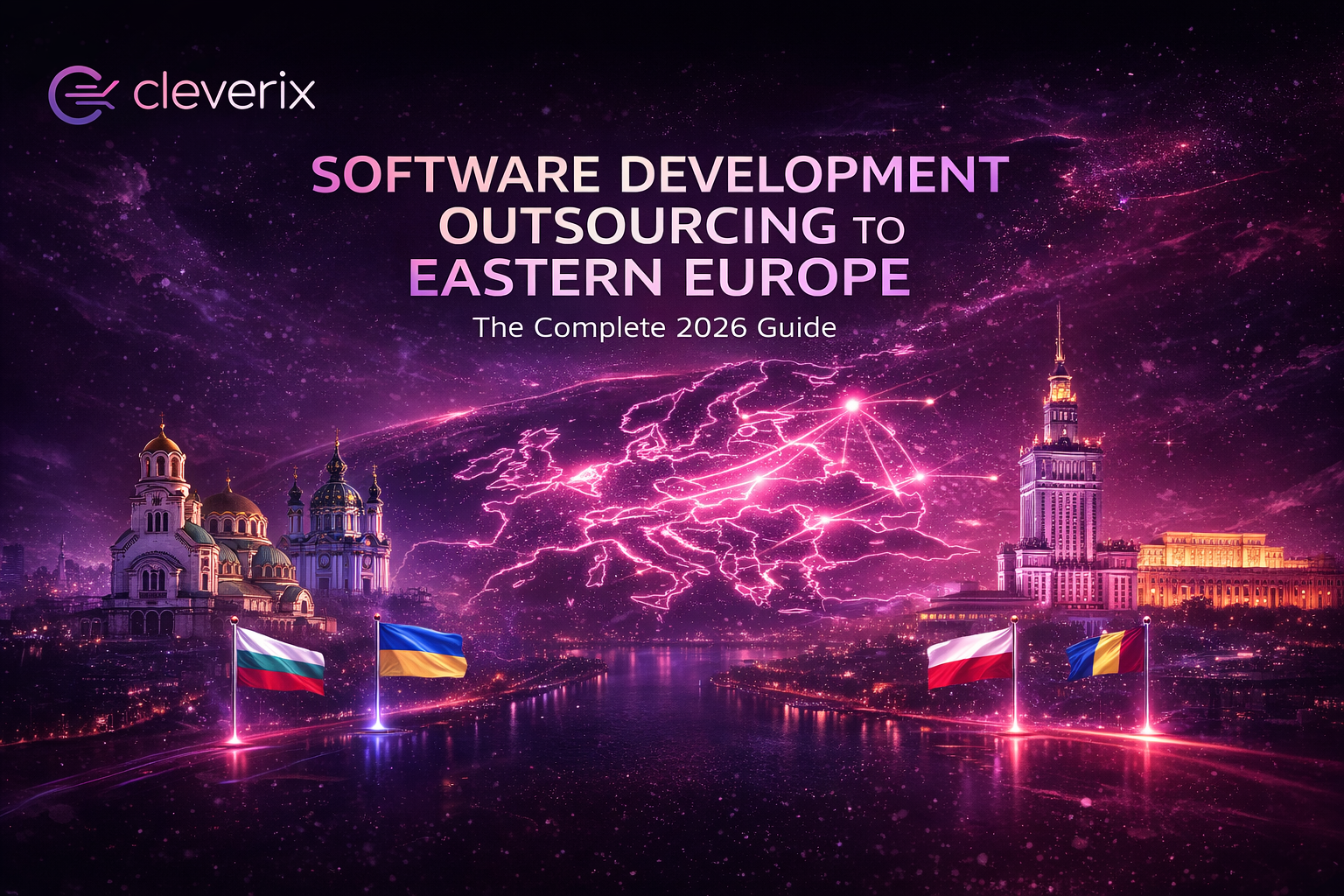
Software Development Outsourcing to Eastern Europe: The Complete 2026 Guide
Software development outsourcing is contracting external teams to handle software engineering — from full product development to QA, DevOps, or mobile apps. Eastern Europe offers technical excellence, cost efficiency, and cultural alignment with Western markets.
Whether you're a startup, scale-up, or enterprise — understanding the Eastern European outsourcing landscape is essential for 2026.
The Global Outsourcing Opportunity
The market continues rapid expansion, driven by Western talent shortages and maturing Eastern European tech ecosystems.
📋 In This Guide
Why Eastern Europe for Software Development Outsourcing?
The region has evolved from "cheap alternative" to strategic choice for companies prioritizing quality and cost efficiency.
World-Class Technical Education
Bulgaria, Poland, and Romania produce tens of thousands of STEM graduates annually. Bulgaria alone has 108,000+ ICT professionals with strong math and engineering foundations.
Time Zone Alignment
Eastern Europe operates within 1-3 hours of CET, enabling real-time collaboration. US East Coast companies get 6-7 hours overlap for daily syncs.
EU Membership & Legal Framework
Bulgaria, Poland, and Romania are EU members — GDPR compliance, IP protection, and stable legal frameworks included.
Cost Efficiency Without Compromise
Senior rates of $35-65/hr vs. $100-180/hr in Western markets. 40-60% savings without sacrificing quality.
Key Insight: Successful outsourcing relationships treat Eastern European teams as strategic partners, not vendors.
Country-by-Country Comparison: Bulgaria, Ukraine, Poland & Romania
Each market has distinct characteristics for your software development outsourcing needs.
Bulgaria
EU Member · Eurozone Candidate · NATO MemberBulgaria has emerged as one of Europe's fastest-growing tech hubs. Sofia hosts VMware, SAP, and Bosch offices alongside a thriving startup ecosystem.
- Lowest costs among EU member states
- Strong QA and testing expertise
- High developer retention (12-15% turnover)
- EU legal framework & GDPR compliance
- Flat 10% corporate and personal income tax
- Smaller talent pool than Poland or Ukraine
- Less brand recognition internationally
- Limited local VC ecosystem
Bulgaria as an IT Outsourcing Hub: Complete 2025 Analysis →
Explore the full analysis of Bulgaria's IT ecosystem, talent landscape, and why global companies are choosing Sofia.
Ukraine
Non-EU · Ongoing Conflict Since 2022Ukraine built one of the world's largest IT outsourcing industries over two decades. The industry has shown remarkable resilience since 2022, though operational considerations require careful evaluation.
- Largest talent pool in CEE region
- Deep expertise across all stacks
- Proven track record with Fortune 500
- Strong startup and product culture
- Competitive rates despite quality
- Ongoing military conflict and uncertainty
- Infrastructure risks (power, internet)
- Mobilization affecting workforce
- Non-EU legal complexity
- Business continuity planning required
Ukraine Market Data (2024): IT exports reached $6.45B, down 4.2% from $6.7B in 2023. The top 50 IT companies reduced headcount by 2,400 positions (2.9%) in H1 2024. Despite challenges, 85% of developers maintained full-time work, and 52% of companies retained 100% of their contracts.
Poland
EU Member · NATO Member · Largest CEE EconomyPoland represents the most mature IT outsourcing market in CEE. With 500,000+ IT professionals and presence of major tech companies, Poland offers scale and sophistication — at a premium.
- Largest talent pool in EU Eastern Europe
- Mature vendor ecosystem
- Excellent English proficiency
- Strong fintech and enterprise expertise
- Closest timezone to Western Europe
- Highest rates in CEE (20-30% above Bulgaria)
- High turnover rates (18-22%)
- Competitive talent market
- Less cost advantage vs. Western Europe
Romania
EU Member · NATO MemberRomania offers a strong middle ground — larger talent pool than Bulgaria, lower costs than Poland. Cluj-Napoca and Bucharest have developed into significant tech hubs.
- Strong technical universities
- Good balance of cost and quality
- Growing startup ecosystem
- Romance language advantage for Western EU
- EU legal framework
- Higher rates than Bulgaria
- Brain drain to Western Europe
- Infrastructure varies outside major cities
Cost Breakdown: Hourly Rates by Country and Role
Rate comparison provides a baseline for budgeting and vendor evaluation.
| Role | Bulgaria | Ukraine | Poland | Romania |
|---|---|---|---|---|
| Senior Developer | $35-55 | $40-60 | $50-80 | $40-65 |
| Mid-Level Developer | $25-40 | $30-45 | $35-55 | $30-50 |
| Junior Developer | $15-25 | $15-25 | $20-35 | $18-30 |
| QA Engineer | $25-45 | $25-45 | $35-55 | $30-50 |
| DevOps Engineer | $35-55 | $40-60 | $50-75 | $40-60 |
| Tech Lead / Architect | $45-70 | $50-75 | $65-100 | $50-80 |
Pro Tip: Rates vary based on technology stack, industry expertise, and vendor tier. Enterprise-grade vendors with certifications (ISO, SOC2) typically charge 15-25% more. Always compare total cost of engagement.
Total Cost of Engagement: Beyond Hourly Rates
Smart buyers evaluate total cost, not just rates:
- Communication overhead: Teams with excellent English reduce meeting time
- Turnover costs: Bulgaria's 12-15% vs. Poland's 18-22% means less knowledge loss
- Legal and compliance: EU states eliminate GDPR transfer complexities
- Travel costs: Sofia is 2 hours from major Western European hubs
- Timezone efficiency: Real-time collaboration reduces project timelines
How to Choose the Right Outsourcing Partner
A great partner in a "less optimal" location outperforms a mediocre partner anywhere.
Evaluate Domain Expertise
Look for partners with proven track records in your specific industry — fintech, healthcare, e-commerce — with verifiable case studies and references.
Assess Communication Quality
Schedule calls with actual team members, not just sales reps. Evaluate English proficiency and their ability to ask clarifying questions.
Verify Technical Capabilities
Request code samples from similar projects and architecture documentation. Strong partners welcome technical due diligence.
Check Retention and Stability
Ask about team tenure, turnover rates, and succession planning. Mature organizations have knowledge management practices in place.
Start Small, Scale Intentionally
Begin with a pilot project. Evaluate delivery quality and cultural fit before committing to larger engagements.
See How We Deliver: Cleverix Client Success Stories →
Explore real-world examples of our work across fintech, banking, iGaming, and e-commerce — with measurable outcomes and client testimonials.
Risk Factors and Mitigation Strategies
Successful organizations acknowledge risks upfront and implement mitigation from day one.
⚠️ Communication Gaps
Misaligned expectations and cultural differences can derail projects.
⚠️ Quality Control
Delivered code may not meet your standards without proper oversight.
⚠️ Intellectual Property
Unclear IP ownership or data security lapses can expose your business.
⚠️ Key Person Dependency
Over-reliance on specific individuals creates continuity risks.
⚠️ Geopolitical Instability
Regional conflicts or political changes can disrupt operations.
🎯 When to Choose Bulgaria for Software Development Outsourcing
- You prioritize cost efficiency within the EU legal framework
- You need strong QA and testing expertise
- You value team stability and low turnover
- You require GDPR compliance without complex data transfer agreements
- You want a strategic nearshore partner, not just a vendor
Frequently Asked Questions
Software development outsourcing is hiring external companies to handle software engineering tasks — from full product development to specific functions like QA, DevOps, or mobile development. Organizations outsource to access talent, reduce costs, accelerate delivery, or scale flexibly.
Eastern Europe offers world-class technical education, 40-60% cost savings vs. Western markets, favorable time zones, strong English proficiency, and EU legal frameworks in countries like Bulgaria, Poland, and Romania.
Senior developer rates range from $35-55/hr in Bulgaria, $40-60 in Ukraine/Romania, and $50-80 in Poland. A 5-person team in Bulgaria costs ~$25,000-40,000/month vs. $60,000-100,000+ in Western Europe.
Ukrainian IT has shown resilience — 85% of developers maintained full-time work. However, infrastructure risks and mobilization concerns require business continuity planning. Many organizations combine Ukrainian teams with backup capacity in EU countries.
Nearshore means nearby countries with similar time zones (Eastern Europe for Western companies). Offshore refers to distant locations (India, Philippines). Nearshore offers real-time collaboration and stronger cultural alignment.
Choose EU partners with strong IP laws. Ensure contracts assign IP ownership, include NDAs, and verify certifications (ISO 27001, SOC2). For sensitive projects, require specific data handling protocols.
Dedicated teams work best for ongoing product development and long-term initiatives. Project-based outsourcing suits well-defined deliverables with clear requirements. Many organizations start project-based to evaluate partners, then transition to dedicated teams as trust develops.
Bulgaria has developed particular strength in QA and software testing, with high concentrations of ISTQB-certified engineers. Combined with the lowest EU rates and strong English skills, Bulgaria is especially attractive for QA outsourcing needs.
Partner with Cleverix
Sofia-based software engineering and QA services for companies across Europe and North America.
Cleverix — software engineering and QA company in Sofia, Bulgaria. Managed QA, Dedicated Teams, App Development.