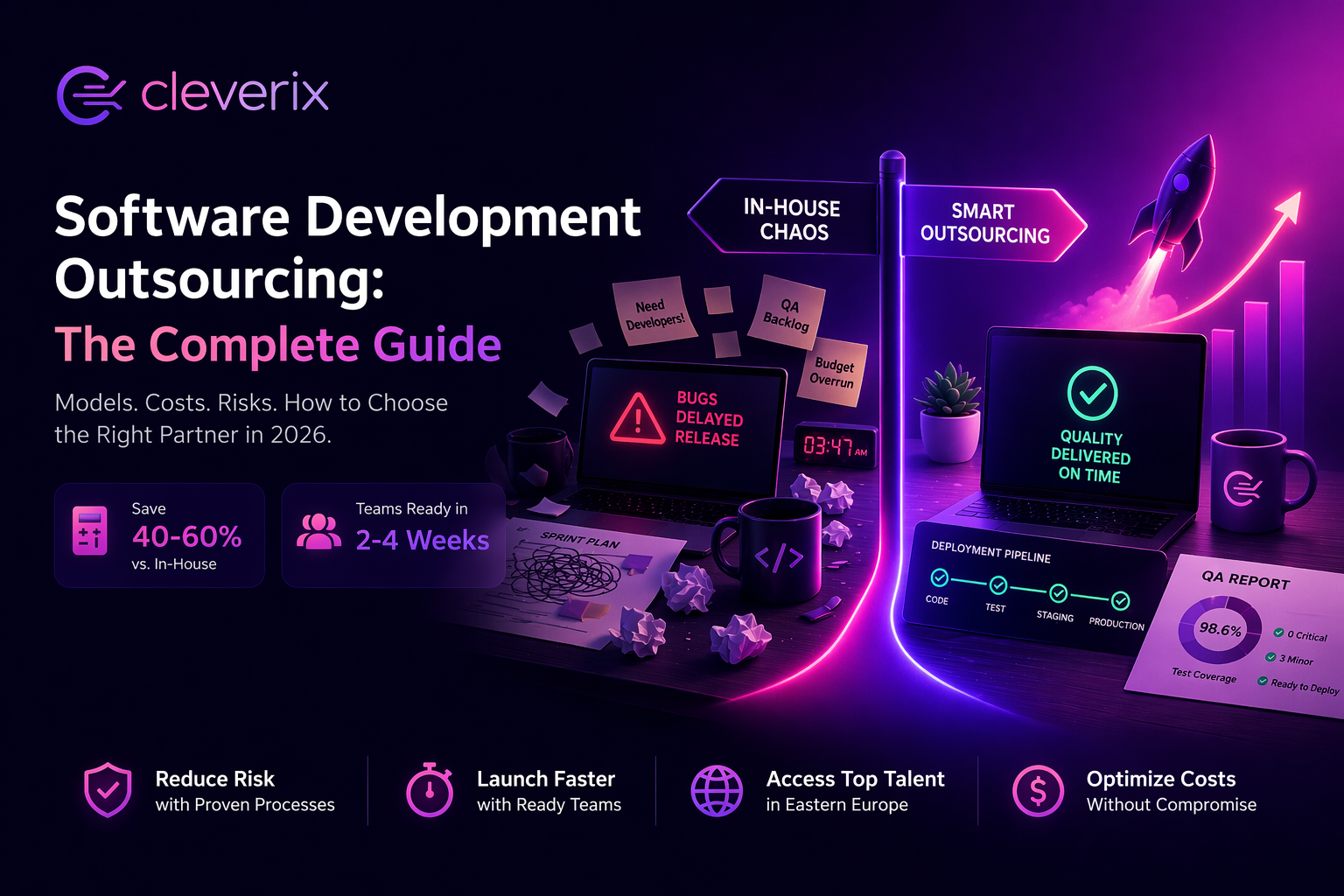
Software Development Outsourcing: The Complete Guide
Software development outsourcing is the practice of hiring external teams to build, maintain, or scale your software products. This guide covers everything you need to make informed outsourcing decisions - from choosing the right model and partner to managing risks and optimizing costs.
Sources: Statista 2024, Deloitte Global Outsourcing Survey 2024
What is software development outsourcing?
Software development outsourcing is the practice of hiring external teams or companies to build, maintain, or scale software products - instead of relying solely on in-house employees. This includes everything from adding individual developers to your team to engaging full delivery partners who manage entire projects.
Organizations outsource software development for four primary reasons: accessing specialized talent that's hard to find locally, reducing costs compared to in-house hiring, scaling capacity quickly without long-term commitments, or accelerating time-to-market by running parallel workstreams.
The most successful outsourcing relationships treat external teams as strategic partners - not vendors. Companies that invest in integration, communication, and cultural alignment consistently report better outcomes than those who simply "hand off" work.
The global IT outsourcing market reached $541 billion in 2024 and is projected to grow to $812 billion by 2029. Source: Statista, IT Outsourcing Market Report 2024
Today, 76% of the world's 2,000 largest companies use some form of IT outsourcing, making it a mainstream strategy rather than a cost-cutting tactic. Source: Deloitte Global Outsourcing Survey 2024
Software development outsourcing is no longer about "cheap labor" - it's a strategic capability for accessing talent, accelerating delivery, and focusing internal resources on core business activities.
Outsourcing models compared
Choosing the right engagement model is critical. Each model offers different levels of control, flexibility, and commitment. Here's how the four main models compare:
| Model | Best for | Control level | Commitment |
|---|---|---|---|
| Staff augmentation | Filling specific skill gaps | High | Flexible |
| Dedicated team | Ongoing product development | Medium-High | Long-term |
| Project-based | Defined deliverables | Low | Fixed scope |
| Managed services | Outcome-based partnerships | Low | SLA-driven |
Staff augmentation is an outsourcing model where individual developers or specialists join your existing team, working under your direct management and following your internal processes. You maintain full control but also carry the management overhead.
Staff augmentation works best when you need specific skills for a defined period - for example, adding two React developers for a 6-month product push, or bringing in a DevOps specialist to set up CI/CD pipelines.
A dedicated development team is a complete unit - typically including developers, QA engineers, and a team lead - that works exclusively on your projects. The outsourcing partner handles hiring, HR, and infrastructure while you direct the work and priorities.
Dedicated teams balance control with operational efficiency. You avoid the overhead of managing individual contractors while maintaining strategic direction over the work. This model suits ongoing product development where requirements evolve over time.
Project-based outsourcing is a fixed-scope engagement where you define requirements and the partner delivers a finished product. Fixed scope, fixed timeline, fixed price.
Project-based works well for well-defined deliverables - a mobile app with clear specifications, a website redesign, or a specific integration. It requires excellent upfront specifications because changes mid-project typically mean renegotiating scope and cost.
Choose staff augmentation for control and flexibility. Choose dedicated teams for ongoing development with less management overhead. Choose project-based for well-defined, one-time deliverables.
How to choose the right partner
Partner selection often matters more than location or pricing. A great partner in a "less optimal" location will outperform a mediocre partner anywhere. Here's a systematic approach:
Define your requirements clearly
Document technical needs, team size, engagement model, and success criteria before starting your search. Ambiguity leads to mismatched expectations.
Evaluate domain expertise
Look for partners with proven experience in your industry - fintech, healthcare, e-commerce. Ask for case studies and verifiable references.
Assess communication quality
Schedule calls with actual team members, not just sales. Evaluate English proficiency, responsiveness, and their ability to ask clarifying questions.
Verify technical capabilities
Request code samples, architecture documentation, and CI/CD practices. Strong partners welcome technical due diligence.
Start with a pilot
Begin with a small, time-boxed engagement. Evaluate delivery quality and cultural fit before committing to larger projects.
Avoid partners who promise unrealistic timelines, can't provide references, have high employee turnover (ask directly), avoid technical discussions, or push for large upfront commitments before proving their value.
Partner selection matters more than location or hourly rates. Follow the 5-step framework: define requirements, evaluate domain expertise, assess communication, verify technical capabilities, then start with a pilot project before scaling up.
Costs and pricing models
Understanding outsourcing costs requires looking beyond hourly rates. The total cost of engagement includes communication overhead, management time, and hidden factors like turnover and ramp-up periods.
Software development outsourcing costs range from $35-55/hour in Bulgaria, $40-65/hour in Romania/Ukraine, $50-80/hour in Poland, to $100-180/hour in Western Europe and the US. These rates are for senior developers; junior and mid-level rates are 30-50% lower.
| Region | Senior developer rate | Timezone (vs CET) | EU/GDPR |
|---|---|---|---|
| Western Europe / US | $100-180/hr | Local | Yes |
| Poland | $50-80/hr | 0 | Yes |
| Romania / Ukraine | $40-65/hr | +1 | Partial |
| Bulgaria | $35-55/hr | +1 | Yes |
| India / Philippines | $20-40/hr | +4 to +6 | No |
Source: Accelerance Global Software Outsourcing Rates 2025; Clutch.co Developer Rate Survey 2024
Common pricing models
- Time & materials (T&M): Pay for actual hours worked. Best for evolving requirements and ongoing development. Typical markup: 20-40% over raw salary costs.
- Fixed price: Set cost for defined scope. Requires detailed specifications upfront. Risk of scope creep or quality shortcuts if specs are ambiguous.
- Dedicated team (monthly retainer): Predictable monthly cost for a committed team. Most common for long-term engagements. Typical: $8,000-15,000/month per developer in Eastern Europe.
- Outcome-based: Payment tied to delivered results or milestones. Aligns incentives but harder to structure fairly.
A 5-person development team in Eastern Europe costs $25,000-45,000/month. The same team in Western Europe or the US costs $80,000-150,000/month. That's 40-60% savings - without compromising on quality if you choose the right partner.
Risks and how to mitigate them
Every outsourcing engagement carries risks. Acknowledging them upfront and implementing mitigation strategies from day one is what separates successful partnerships from failed projects.
⚠️ Communication gaps
Risk: Misaligned expectations, cultural differences, language barriers.
Mitigation: Clear protocols, regular video calls, overlapping work hours (minimum 4 hours), and partners with proven Western cultural alignment.
⚠️ Quality issues
Risk: Delivered code doesn't meet standards or contains hidden technical debt.
Mitigation: Code reviews, automated testing requirements, QA certifications (ISTQB, ISO), clear acceptance criteria, and trial projects before large commitments.
⚠️ IP and security
Risk: Unclear ownership, data breaches, or leaked proprietary information.
Mitigation: EU jurisdictions with strong IP laws, explicit IP assignment in contracts, comprehensive NDAs, SOC2/ISO 27001 certifications.
⚠️ Key person dependency
Risk: Critical knowledge locked in individuals who may leave.
Mitigation: Documentation standards, minimum team sizes (avoid single-person engagements for critical work), knowledge sharing practices, and succession planning.
The four biggest outsourcing risks are communication gaps, quality issues, IP security, and key person dependency. All four can be mitigated through proper partner selection, clear contracts, and structured processes - they're manageable, not inevitable.
Best regions for software development outsourcing
Location matters - but perhaps not in the way you think. The "best" region depends on your priorities: cost, timezone overlap, legal framework, or specific technical expertise.
Nearshore outsourcing means partnering with teams in nearby countries that share similar timezones and cultural context. For Western European companies, this typically means Eastern Europe (Bulgaria, Poland, Romania). For US companies, this means Latin America (Mexico, Brazil, Argentina).
Offshore outsourcing means partnering with teams in distant locations - typically India, Philippines, or Vietnam for Western companies. Offshore offers maximum cost savings but requires asynchronous workflows due to 8-12 hour timezone differences.
Eastern Europe (nearshore for Western EU)
Bulgaria, Poland, Romania, and Ukraine offer strong technical education, EU/Western business culture alignment, and 40-60% cost savings versus Western rates. Real-time collaboration is possible with just 1-3 hours timezone difference from Central Europe.
Bulgaria and Poland are EU member states with full GDPR compliance and strong IP protection. Ukraine offers a larger talent pool but requires business continuity planning due to ongoing geopolitical factors.
India (offshore, cost-optimized)
India has the largest IT talent pool globally with mature outsourcing processes developed over 30+ years. However, the 5-10 hour timezone difference from Europe requires well-structured asynchronous workflows. Best suited for well-defined projects, 24/7 support models, or organizations with experience managing distributed teams.
Latin America (nearshore for US)
Brazil, Mexico, Argentina, and Colombia share similar timezones with US teams and increasingly strong technical ecosystems. Cultural alignment with North American business practices is generally higher than Asian alternatives.
Bulgaria offers the lowest developer rates among EU member states ($35-55/hr for seniors) combined with strong technical education, low turnover (12-15% vs 18-22% in Poland), and a flat 10% tax rate that attracts and retains talent. Sofia hosts engineering centers for VMware, SAP, Uber, and Bosch. For companies prioritizing EU compliance and cost efficiency, Bulgaria represents an optimal balance. Source: Clutch.co, Bulgarian ICT Cluster 2024
Choose nearshore (Eastern Europe for EU, Latin America for US) when real-time collaboration and cultural alignment matter. Choose offshore (India, Philippines) when cost is the primary driver and you can structure work asynchronously.
Frequently asked questions
Ready to explore outsourcing?
Cleverix helps companies across Europe build, test, and scale software products through dedicated engineering teams and managed QA services. Let's discuss your requirements.