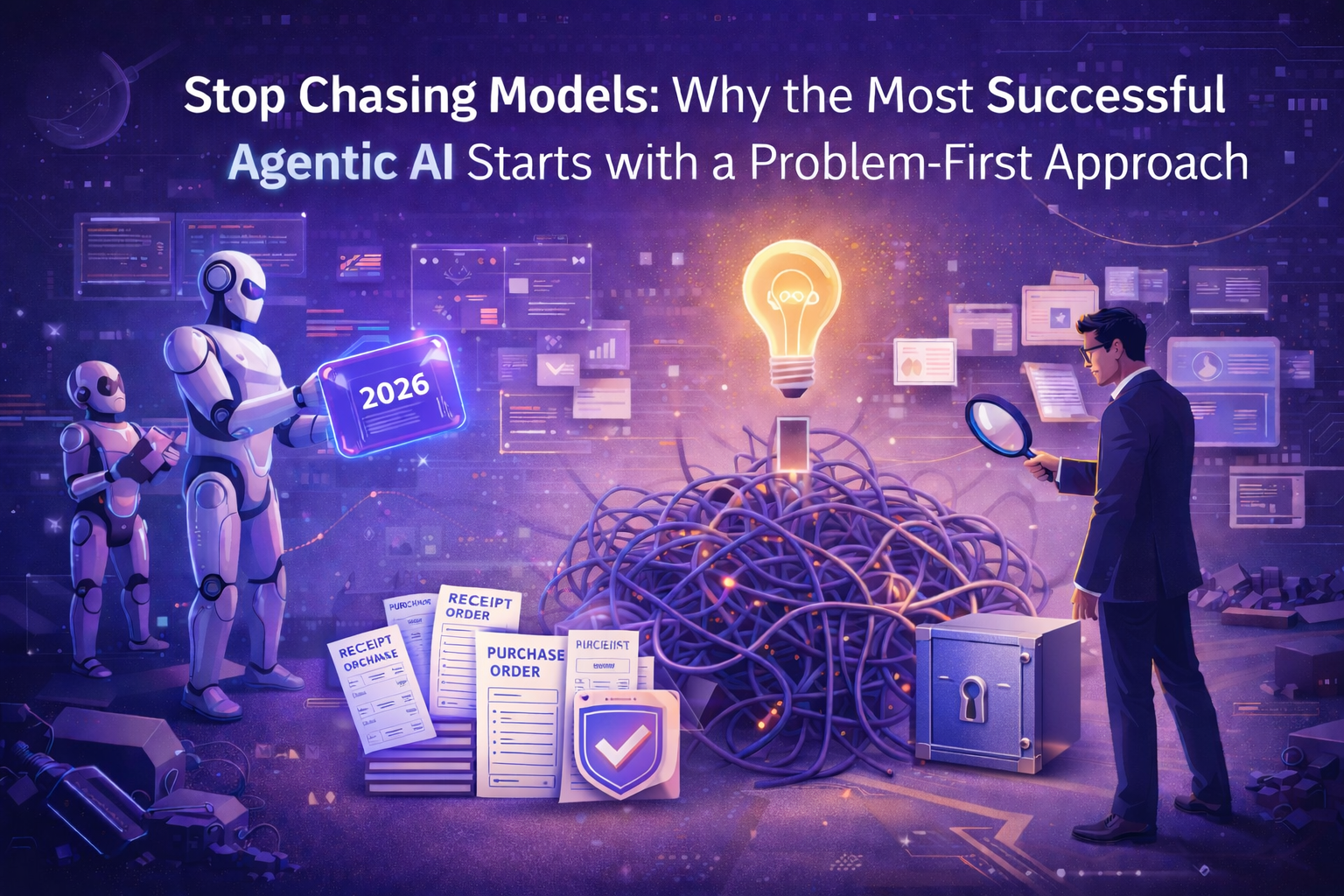
The "Shiny Object" Trap Is Back - and the Stakes Are Higher
When generative AI arrived in force, enterprises rushed to deploy LLMs. They launched chatbots that could summarize meeting notes and draft emails with confidence. What followed was a graveyard of underused tools: software that could write poetry but could not process a single invoice without a human in the loop. The problem was never the model. It was the absence of a "why."
AI That Takes Action Changes Everything
Unlike a passive language model that generates text and waits, an AI agent takes action. It queries live databases, writes to CRMs, triggers API calls, and makes decisions that propagate downstream through your systems.
When you grant autonomy to software, the cost of a misaligned "why" is no longer a mildly unhelpful chatbot - it is a workflow running in the wrong direction at machine speed.
The antidote is straightforward, but it requires discipline: building agentic AI applications with a problem-first approach - defining the operational friction before touching a single line of code or selecting a model.
What Does "Problem-First" Actually Mean?
Most organizations fall into technology-first thinking by default. A vendor demos an impressive model. Leadership approves a budget. Engineers start building. Months later, the team is hunting for a use case to justify the spend.
🔁 Technology-First vs. Problem-First
Technology-First: Buy an expensive model, then search for a use case. The architecture is determined by what the model can do.
Problem-First: Identify a specific bottleneck - "reduce contract review time by 70%" - and build a scoped agent to clear it. The business outcome dictates the architecture.
Every well-designed agentic AI application rests on three pillars. Define all three on paper before any code is written, and the technology selection becomes obvious rather than aspirational.
The 3 Pillars of Problem-First Agent Design
- Observability: What specific data does the agent need to "see" in order to make a decision? Define the inputs before you define the model.
- Reasoning: What logic must the agent apply? The complexity of the reasoning determines the appropriate model size - not vendor hype.
- Actionability: Which specific systems - APIs, ERPs, CRMs - must the agent have the power to modify? Listing these explicitly at the design stage is also your first security checkpoint.
How Do You Build an Agent the Right Way? A 4-Step Framework
Identify "Decision Friction"
Look for tasks where human experts are currently functioning as manual routers or validators - matching invoices to purchase orders, triaging security alerts, routing customer escalations. These are repeatable, rules-based decisions that happen to require human bandwidth because no structured system has been built to handle them. That is where agents deliver the fastest AI agent ROI.
Decompose the Workflow into Micro-Tasks
A well-scoped agent should not "run the department." It should "reconcile payment discrepancies flagged in the ERP." Breaking a large process into atomic micro-tasks keeps the agent's reasoning focused and makes failure modes traceable. When an agent handles a single, well-defined decision, you know exactly where to look if something goes wrong.
Define Success Metrics Before You Build
Do not measure "accuracy." Accuracy is a training metric, not a business metric. Agree on operational KPIs before development begins: Resolution Rate (% of cases resolved without human escalation), Lead Time Reduction (process cycle compression), and Cost-Per-Transaction versus the human baseline. Without pre-agreed metrics, you have no objective definition of done.
Select the Minimal Viable Model
Does this problem need a frontier-scale model, or can a smaller, faster Small Language Model (SLM) handle the specific logic more cheaply? A three-way invoice match does not require a model that writes graduate-level prose. SLMs trained on domain-specific data frequently outperform large general-purpose models on narrow tasks while costing a fraction of the price per inference. The problem-first framework makes this choice rational rather than aspirational.
Case Studies: What This Looks Like in Production
Finance: Document Inquiry Triage
A major financial institution's challenge was not "implementing AI" - it was answering thousands of vendor document queries across a corpus of 250,000+ documents efficiently enough that analysts were not buried in lookup tasks. The agent built to solve this problem did not need to reason about unstructured text in general. It needed to observe a well-indexed document store, apply retrieval logic to incoming queries, and route confirmed answers without human review.
Retail: Autonomous Three-Way Match
Accounts payable delays in retail often trace back to one friction point: the manual reconciliation of invoices, purchase orders, and goods receipts. An agent built specifically for three-way matching - observing three data sources, applying a defined set of matching rules, and flagging exceptions for human review - reliably compresses AP cycle time without requiring the agent to understand anything about the broader business.
💡 The Lesson Both Cases Share
These organizations did not build "General AI." They built specialized, scoped agents for specific operational problems, then measured the results against pre-agreed KPIs. That is what sustainable AI agent ROI looks like in practice. They built specialized employees, not general intelligences.
Model-First vs. Problem-First: How They Compare
| Dimension | Technology-First | Problem-First |
|---|---|---|
| Starting point | Vendor demo / budget approval | Documented operational bottleneck |
| Architecture driver | Model capabilities | Business outcome KPIs |
| Model selection | Biggest available model | Minimal viable model for the task |
| Security posture | Broad access, restricted later | Least privilege from day one |
| Success metric | "Accuracy" score | Resolution Rate / Cost-per-Transaction |
| Failure mode | Impressive demo, zero adoption | Narrow failure with clear root cause |
Why Outsourcing the "Problem Discovery" Is Smarter Than Outsourcing the Code
In 2026, writing Python to connect an LLM to a set of tools is not the bottleneck. The bottleneck is the Discovery Phase: correctly identifying which workflow contains the friction worth solving, decomposing it with enough precision that an agent can act on it reliably, and ensuring governance is in place before the agent goes live.
🔒 Why Problem-First = Better Security by Default
- When the agent's scope is defined before its architecture, it is straightforward to apply the Principle of Least Privilege - granting access only to the specific tools and data sources required for the defined task.
- Technology-first projects provision broad access upfront and attempt to restrict it later - creating attack surface and governance debt that is expensive to unwind.
- Autonomous workflows for enterprise built problem-first are easier to audit, explain, and defend to regulators.
This is why enterprises are increasingly seeking partners who can perform Agentic Audits - structured assessments that map existing workflows, identify decision friction points, and rank candidate agent deployments by expected return on investment.
Closing the final reliability gap requires managed QA for agentic AI at the deployment stage: validating that the agent's behavior in production matches its behavior in testing, and that exception handling is verified before the system runs unsupervised.
You can see how Cleverix has applied this discovery-first approach on our Case Studies page, including workflow modernization projects where scoping decisions made upfront determined the success of the final system.
What to Verify Before Your Agent Goes Live
- The problem is documented as a specific operational bottleneck, not a broad AI goal
- Observability, reasoning, and actionability are all defined before any model is selected
- Success KPIs are agreed upon and baselined before development begins
- The agent's tool access list is the minimal set required for its defined task
- Exception handling and human escalation paths are tested, not assumed
- Managed QA has validated production behavior against staging behavior
Frequently Asked Questions
A problem-first approach means identifying a specific operational bottleneck or decision friction point before selecting any AI model or writing any code. Instead of buying a powerful LLM and searching for a use case, you define a measurable business outcome first - such as reducing contract review time by 70% - and then build the minimal agent architecture needed to achieve it.
Effective AI agent ROI measurement focuses on operational metrics rather than technical accuracy scores. Key KPIs include Resolution Rate (the percentage of cases the agent resolves without human escalation), Lead Time Reduction (the decrease in process cycle time), and Cost-Per-Transaction compared to the human baseline. These metrics tie directly to business value rather than model performance.
The best candidates are workflows where human experts currently act as manual routers or validators - tasks that are repeatable, rules-based, and well-documented, but consume significant expert bandwidth. Examples include invoice-to-PO matching, security alert triage, document inquiry routing, and compliance screening. The clearer the rules, the stronger the case for an agent.
Managed QA for agentic AI is a continuous quality assurance process that validates agent behavior across production-like scenarios - not just unit-level accuracy. It ensures that the agent handles edge cases, escalates correctly when uncertain, and behaves consistently as the underlying model or tools are updated. Because agents take real actions in real systems, QA failures have operational consequences that a standard software QA process is not designed to catch.
An Agentic Audit is a structured discovery process where an external team maps your existing workflows, identifies where human experts are acting as manual routers or validators, and ranks potential agent deployments by expected ROI. If your organization has an AI budget but no clear deployment roadmap, or if previous AI projects underdelivered, an Agentic Audit is the right starting point. The challenge in 2026 is not writing the code - it is knowing precisely which problem is worth solving.
Start with the Right Problem
Book a free consultation and we'll map the highest-ROI agentic AI opportunities within your existing workflows - before a single line of code is written.
We are a Sofia-based software engineering and QA company helping product teams build, test, and maintain complex digital systems. From managed QA services to full-stack development and agentic AI implementation, we combine European engineering standards with nearshore efficiency.
www.cleverix.com