Software Development Life Cycle: Complete Guide to Processes, Phases, and Models (2026)
The software development life cycle (SDLC) is the end-to-end process organizations use to plan, build, test, deploy, and maintain software. A well-run SDLC turns a business idea into working software while controlling cost, quality, and risk. This guide walks through the six phases, the main SDLC models (Waterfall, Agile, DevOps, Spiral, V-model, Iterative), where security fits, and how to choose the right approach for your project.
Every software project passes through six core SDLC phases: planning, design, development, testing, deployment, and maintenance. What differs is the model you wrap around them. Agile now dominates, with around 97% of organizations using it to some degree and a 75% project success rate versus 56% for traditional approaches. Modern SDLCs also embed security from day one, because fixing a bug in production costs roughly 100x more than catching it in design.
Software delivery has consolidated around Agile and DevOps, but the cost of getting the process wrong has also gone up, driven by security and supply-chain risk.
What is the software development life cycle?
The software development life cycle is a structured set of processes that takes software from an initial idea to a production system and its ongoing evolution. It defines what work happens in each phase, what artifacts each phase produces, how phases hand off to one another, and how the team manages risk, quality, and scope throughout.
The SDLC exists because software projects are hard to get right. The Standish Group's CHAOS research has consistently shown that around 31% of software projects fail outright and more than half run into serious cost or schedule overruns. McKinsey's research on large IT programs found they typically run 45% over budget and deliver 56% less value than predicted. A repeatable SDLC, whether built in-house or through a structured outsourcing engagement, is how organizations close that gap.
Crucially, the SDLC is not the same thing as a methodology. The phases (planning, design, build, test, release, maintain) are broadly universal. The methodology you choose, Agile, Waterfall, DevOps, and others, decides how you sequence and iterate through those phases.
The 6 phases of the software development life cycle
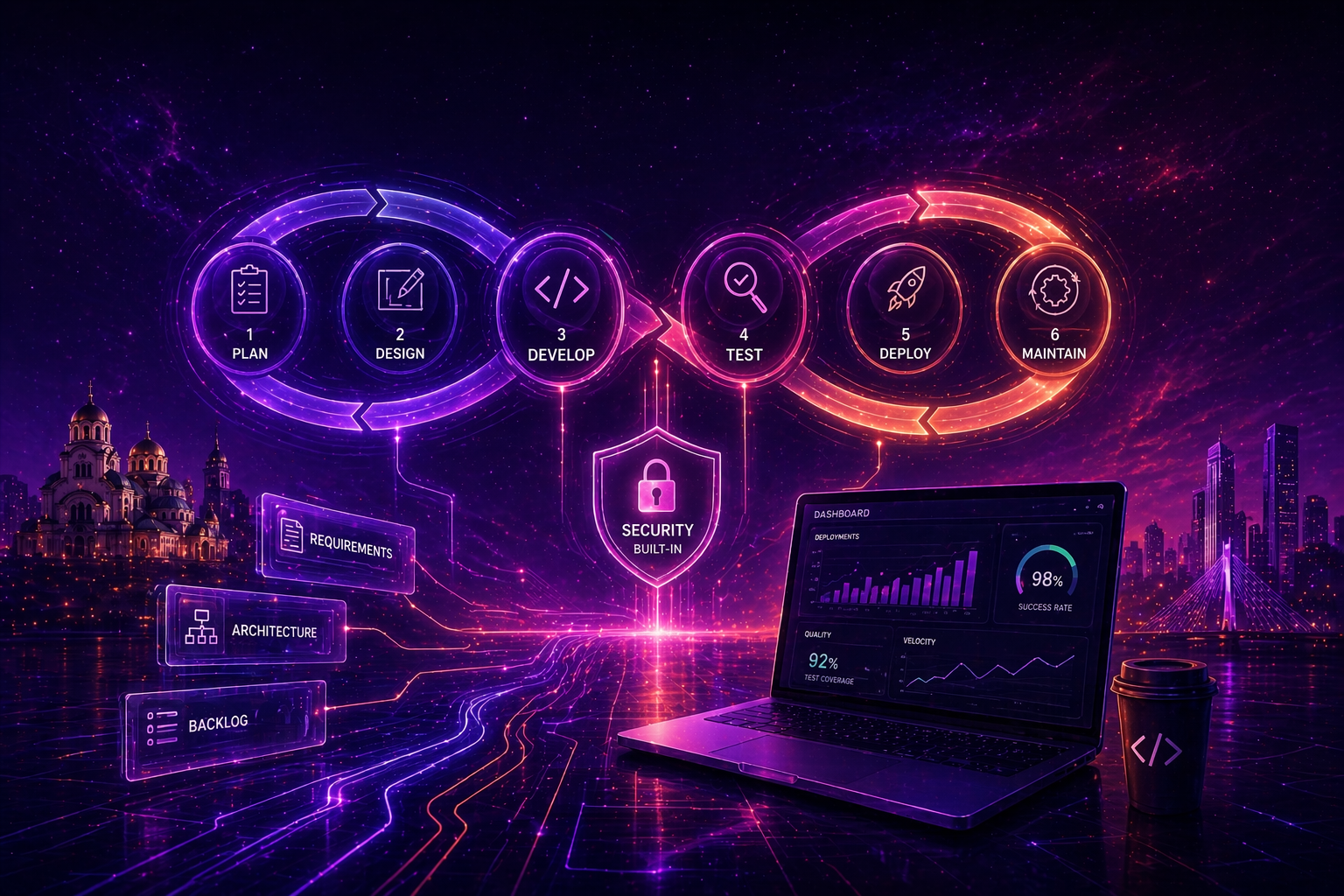
Most modern SDLC frameworks collapse the process into six well-defined phases. Each phase has clear entry criteria, deliverables, and a handoff point to the next phase. Teams using Agile or DevOps still pass through every phase, they just run them in short overlapping cycles instead of one long sequence.
Planning and requirements
Define the business problem, scope, stakeholders, budget, timeline, and success criteria. Capture functional and non-functional requirements. Confirm feasibility and align on priorities before any design work begins.
Deliverable: requirements document, project charterDesign and architecture
Translate requirements into technical design: system architecture, data models, APIs, integrations, UI flows, security controls, and infrastructure choices. Good design here prevents expensive rework later in the cycle.
Deliverable: architecture diagrams, technical specDevelopment
Engineers write, review, and merge code against the approved design. Version control, coding standards, unit tests, and peer review are table stakes. Modern teams run security scans (SAST, dependency checks) directly in the CI pipeline. Many organizations scale this phase through dedicated development teams that integrate with internal engineering.
Deliverable: source code, unit tests, build artifactsTesting and quality assurance
Verify the software does what it should and does not do what it should not. Functional, integration, regression, performance, and security testing all live here. Mature teams automate most checks and keep manual effort for exploratory and UX testing, which is why many organizations bring in QA as a Service to own this phase end-to-end.
Deliverable: test results, defect log, coverage reportDeployment
Release the software to staging, then production. Blue-green or canary deployments reduce risk by limiting initial exposure. Automated deployment pipelines, infrastructure-as-code, and rollback plans are the modern baseline, usually owned by a DevOps and cloud operations team.
Deliverable: release package, deployment runbookMaintenance and evolution
Monitor the live system, fix defects, patch vulnerabilities, tune performance, and ship improvements. For most products this is the longest phase of the SDLC by far. Monitoring, observability, and on-call practices determine whether it is calm or chaotic.
Deliverable: patches, monitoring data, incident reportsIEEE standards (notably IEEE 12207) and the ISO/IEC 12207 process framework formalize these phases for regulated industries. For most commercial teams, the practical day-to-day question is not "what are the phases" but "how do we iterate through them safely and quickly".
SDLC models: Waterfall, Agile, DevOps, Spiral, V-model, Iterative
An SDLC model is the pattern you use to move through the six phases. The main ones trade off predictability, flexibility, time-to-market, and risk in different ways. Below is a practical comparison of the six you are most likely to encounter.
| Model | How it works | Best for | Flexibility | Time to market |
|---|---|---|---|---|
| Waterfall | Sequential. Each phase completes before the next begins. | Fixed scope, heavy regulation, hardware-linked systems. | Low | Slow |
| Agile | Short iterative cycles (1-4 weeks) revisiting all phases. | Evolving requirements, customer-facing products, most SaaS. | High | Fast |
| DevOps | Agile plus automated CI/CD, shared ownership of code and ops. | Cloud-native products, high release frequency, platform teams. | High | Very fast |
| Spiral | Risk-driven loops; each loop tackles the biggest remaining risk. | Large, complex, high-risk systems (aerospace, defense). | Medium | Slow |
| V-model | Waterfall with a paired test phase for every build phase. | Safety-critical systems that need strong verification. | Low | Slow |
| Iterative | Build a rough version, refine it over repeated passes. | Projects where requirements clarify through working software. | Medium-high | Medium |
In practice, Agile and DevOps now dominate. Recent industry data shows around 97% of organizations using Agile to some extent and 71% applying it specifically within their SDLC, while 74% of companies have adopted DevOps. Elite DevOps teams, per Google's DORA research, deploy roughly 46 times more frequently than low performers and recover from failures over 2,600 times faster.
Sources: State of Agile 2026, Google DORA research.
The sharpest dividing line in 2026 is not Agile vs Waterfall but how deeply AI is embedded in the SDLC. Stack Overflow's 2025 Developer Survey found 84% of developers now use or plan to use AI tools in their workflow, with AI code generation, test generation, and code review increasingly treated as standard SDLC capabilities rather than experiments. For how to apply this in practice, see our take on a problem-first approach to agentic AI.
Security in the SDLC: why shift-left matters
Modern SDLCs bake security into every phase rather than bolting it on at the end. This shift-left approach is usually called Secure SDLC (SSDLC) or DevSecOps. Its logic is simple economics: fixing a vulnerability during design costs roughly 100 times less than fixing the same issue in production, and the downstream cost of a breach has only grown.
IBM's 2024 Cost of a Data Breach report put the average global breach at $4.88 million. The same study found that organizations with high DevSecOps adoption saved nearly $1.7 million per breach compared to those without. Organizations that consistently apply secure SDLC practices also report up to 85% reduction in vulnerabilities reaching production.
According to Verizon's 2025 DBIR, 30% of breaches now involve a third party, and 88% of basic web application attacks rely on stolen credentials. That pushes supply-chain controls (SBOMs, dependency scanning) and identity hygiene directly into the SDLC, not just into the security team's scope.
What "secure SDLC" looks like in practice
Planning
Threat modeling, compliance requirements (GDPR, HIPAA, PCI-DSS), security acceptance criteria.
Design
Secure architecture review, authentication and authorization patterns, data-handling decisions.
Development
Secure coding standards, SAST and SCA scans in the IDE and CI, secrets management.
Testing
DAST, penetration testing, fuzzing, dependency vulnerability checks, abuse-case testing.
Deployment
Signed artifacts, least-privilege access, infrastructure-as-code scanning, runtime protection.
Maintenance
Continuous monitoring, patch cadence, vulnerability disclosure process, incident response drills.
NIST's Secure Software Development Framework (SP 800-218) is the reference most regulated buyers will ask you about. It groups practices into four areas: Prepare the Organization, Protect the Software, Produce Well-Secured Software, and Respond to Vulnerabilities. If you need a practical starting point, map your current SDLC against those four headings and address the biggest gap first.
Source: IBM - Secure Software Development Life Cycle, NIST SP 800-218 (SSDF).
How to choose the right SDLC model
There is no universally "best" SDLC model. The right choice depends on five variables: requirement stability, regulatory load, release cadence, team maturity, and customer involvement. Work through them in order.
- How stable are requirements? Highly stable and well-understood points toward Waterfall or V-model. Evolving or ambiguous requirements point toward Agile, DevOps, or Iterative.
- How heavy is the compliance load? Safety-critical or heavily audited domains (medical devices, aviation, some financial systems) often mandate V-model or a controlled Waterfall. Most others do not.
- How often do you need to release? Multiple times a week points to DevOps. Once per quarter can be handled by Agile without full CI/CD. Once per year fits Waterfall.
- How mature is the team? DevOps assumes strong automation, monitoring, and on-call practices. Teams without those foundations usually get more value from plain Agile first.
- How involved is the customer? Continuous feedback favors Agile or DevOps. Fixed contracts with minimal mid-project input lean toward Waterfall.
Most of the projects we engage on, fintech, iGaming, payments, microservices, fit an Agile or DevOps SDLC with a strong QA layer embedded in every sprint. Regulatory constraints rarely require Waterfall in these domains; they require strong documentation, traceability, and controlled deployments, which Agile and DevOps can deliver when properly set up. See our case studies for concrete examples.
Common SDLC pitfalls and how to avoid them
Most SDLC failures are not caused by the model choice. They are caused by a handful of recurring process and team problems. Here are the five we see most often.
-
1Treating requirements as fixed when they are not Locking scope at kickoff and punishing change requests pushes teams toward cutting corners in testing and documentation. Build change into the plan instead.
-
2Skipping or compressing the testing phase Under deadline pressure, testing is the first thing squeezed. The result is production defects that cost far more than the time saved. Automate regression so you cannot skip it.
-
3Bolting security on at the end Security reviews at release time create painful rework or get waived under pressure. Embed checks in CI from the first sprint, not the last.
-
4No clear definition of done Without shared acceptance criteria (code reviewed, tests passing, docs updated, deployed to staging), "done" silently means "demoed once". Write the definition down.
-
5Neglecting the maintenance phase Teams over-invest in the initial build and under-invest in the 5+ years of operation that follow. Budget for observability, on-call, patching, and refactoring from day one.
SDLC best practices for 2026
The habits that separate high-performing teams from the rest are surprisingly consistent across industries. If you do only a handful of things well, make them these.
Automate the boring parts
Builds, tests, deployments, and security scans all belong in CI/CD. Human attention is too expensive to spend on work a pipeline can do reliably.
Measure with DORA metrics
Deployment frequency, lead time for changes, change failure rate, and mean time to restore are the four numbers that correlate with delivery performance and business outcomes.
Shift security left
Threat-model in design, scan in development, test in staging, monitor in production. Never let "security" become a single gate at the end.
Keep the feedback loop tight
Demo to real users every 1-2 weeks. Small, frequent course corrections cost far less than one big one six months in.
Document the decisions, not just the code
Architecture Decision Records (ADRs) prevent the "why did we do it this way" question from burning an afternoon six months later.
Plan for the maintenance phase
If maintenance will last 5+ years, design for observability, easy rollback, and knowledge transfer from day one of the SDLC.
How Cleverix runs the SDLC for its clients
At Cleverix, we operate across the full SDLC through four service models: dedicated engineering teams, QA as a Service, DevOps and cloud operations, and project-based application development. Most of our engagements use an Agile or DevOps SDLC with an ISTQB-certified QA layer running in parallel to development, so testing is never compressed when deadlines tighten.
We have applied this approach across fintech platforms, payments infrastructure, iGaming systems, and microservices at scale. The constant across industries is the same: clear phase deliverables, automated testing and security scanning, and tight feedback loops with the client product team. If you want to see how this looks end-to-end, the best starting points are our case studies, our guide to outsourcing software development to Eastern Europe, and the deeper look at Bulgaria as an IT outsourcing hub.
Frequently asked questions
The six phases are planning and requirements, design and architecture, development, testing and QA, deployment, and maintenance. Each phase produces specific deliverables (for example requirements documents in planning, architecture diagrams in design) and passes ownership to the next phase through defined acceptance criteria.
Waterfall runs SDLC phases sequentially with one full pass from requirements to deployment. Agile runs short iterative cycles (usually 2-4 weeks), revisiting phases continuously and releasing working software frequently. Industry data shows Agile projects succeeding at around 75% versus 56% for traditional methods.
Most startups are best served by Agile (specifically Scrum or Kanban) because requirements change quickly and early customer feedback is critical. Waterfall rarely fits startups because it assumes requirements are fully known upfront. Lean or hybrid approaches are worth considering if you face heavier compliance controls.
DevOps is an SDLC approach that merges development and operations into a continuous delivery pipeline. It automates testing, deployment, and monitoring so teams can release software multiple times per day. Elite DevOps teams deploy around 46 times more frequently than low performers, according to Google's DORA research.
Modern SDLCs embed security in every phase through DevSecOps or Secure SDLC practices. This shift-left approach catches vulnerabilities during design and development, when fixing them costs about 100 times less than after production. IBM's 2024 Cost of a Data Breach report found high DevSecOps adoption saved around $1.7 million per breach on average.
Yes. Most organizations outsource specific phases (commonly testing, development, or maintenance) or engage dedicated teams that own the full cycle. Successful outsourcing requires clear acceptance criteria per phase, documented handoffs, and shared tooling for requirements, code review, CI/CD, and monitoring.
Planning produces a project charter and requirements document. Design delivers architecture diagrams and technical specifications. Development produces source code and unit tests. Testing yields a test report and defect log. Deployment results in a release package and runbook. Maintenance produces ongoing patches, monitoring data, and incident reports.
There is no single answer. A small SaaS feature can move through an Agile SDLC in one or two weeks. A regulated enterprise system using Waterfall can take 12 to 24 months. The key variables are scope, team size, methodology, compliance requirements, and the quality of requirements at the start.
Modern teams use DORA metrics (deployment frequency, lead time for changes, change failure rate, time to restore service) combined with quality signals like defect escape rate and customer NPS. Top-performing teams keep change failure rates below 15% while deploying multiple times per day.
Need help running your SDLC?
Whether you are setting up an Agile delivery pipeline, adding a QA layer, or scaling an engineering team, we can help. Book a 30-minute call with our team.
Related reading
Cleverix is a Sofia-based software engineering and QA company. We help clients across Europe and North America build, test, and scale software through dedicated engineering teams, QA as a Service, and application development. ISTQB-certified QA, Clutch Premier Verified, and recognized as Top QA Bulgaria 2025.